Why Your Door Won't Latch in Las Vegas—and How to Find the Real Cause
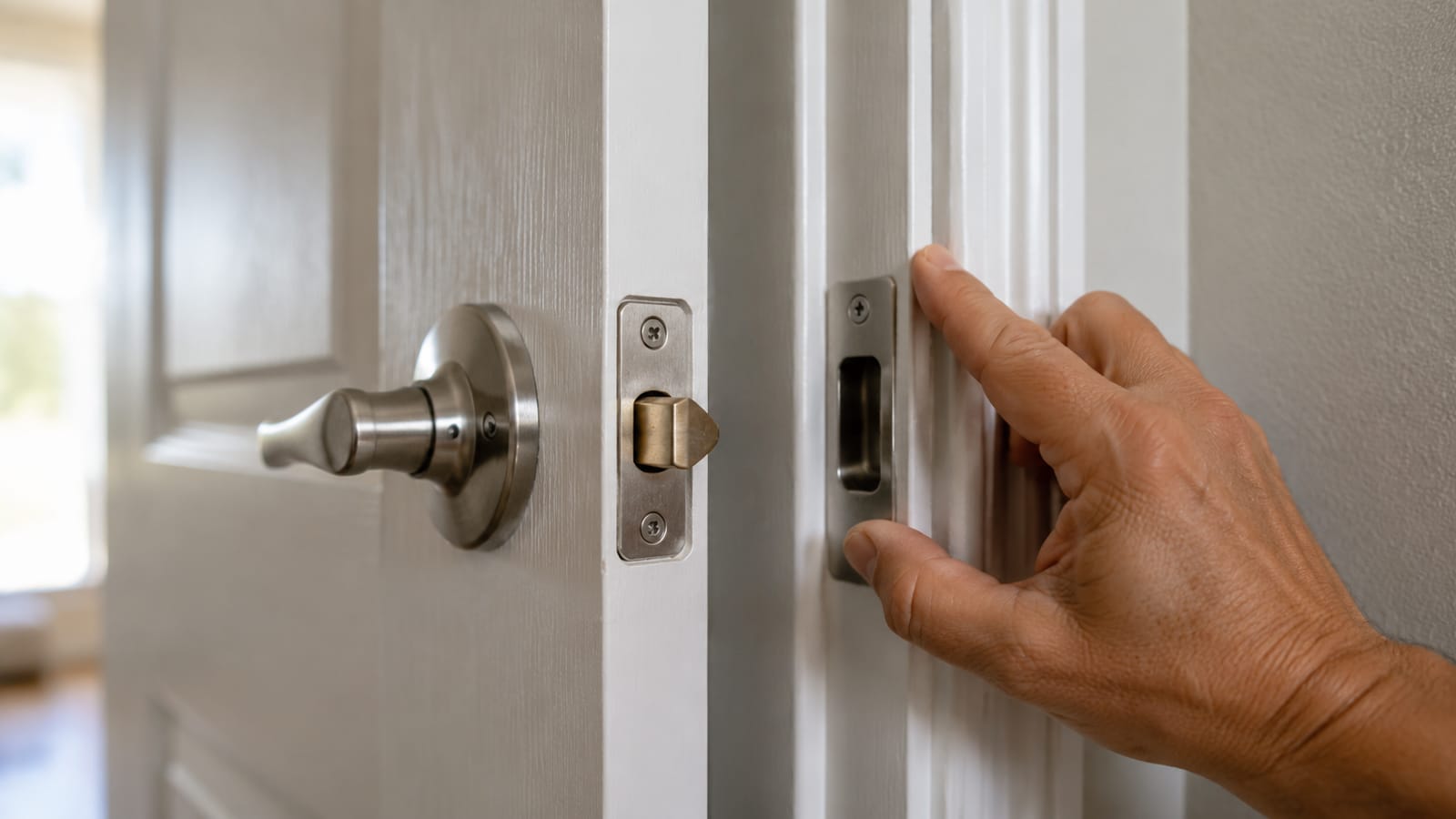
A latch that misses is a symptom, not the diagnosis. Check where the door rubs, how the latch meets the strike, the hinges and installation, and whether the slab is warped — before replacing the lockset.
Severity
Moderate
DIY Friendly
Diagnosis yes, repair sometimes
Time
10 minutes to check
What You Notice
The door closes but the latch doesn't catch, or it only latches if you lift, lean on, or shove it.
What It Means
The door and the frame are no longer in the same relationship they were in when it was hung.
When To Call
The door is exterior and won't secure, the jamb is damaged, or adjustments stop holding.
What I Usually Find
Call Today If You Notice
- ◆An exterior door that no longer secures
- ◆Shiny rub marks on the door edge or strike plate
- ◆Uneven gap along the top or the latch side
- ◆A jamb that is split, soft, or repeatedly re-drilled
“Almost nobody calls me about hinges. They call because a door won't shut. The latch is just the part that finally made the problem obvious.”
Your door closes. The latch doesn't catch. Maybe it catches if you lift the knob, or lean a shoulder into it, or push at exactly the right spot.
Almost everyone reaches for the same conclusion: the lock is worn out. So a new lockset goes on, and the door still doesn't latch — because the lock was never the problem.
A latch that misses is a symptom. It tells you the door and the frame are no longer in the same relationship they were in when the door was hung. It does not tell you why.
That "why" is the whole job. Here is the order I work through it.
1. Find where the door is hanging up
Before touching the latch, I watch the door move. Close it slowly and look at where it makes contact — the top corner, the latch-side edge, the floor, somewhere along the jamb.
Rub marks are the giveaway. A door that has been dragging leaves a polished or scuffed line exactly where it has been touching. That mark tells you which direction the door has moved relative to the opening, which narrows the cause before you've picked up a tool.
If the door swings freely and only fails at the very last moment, that points at the latch and strike. If it drags on the way, the problem is bigger than the strike plate.
2. Read how the latch meets the strike
Now look at the latch itself. Put a piece of painter's tape over the strike plate, or rub a pencil on the latch bolt, close the door, and open it again. You'll see exactly where the bolt is landing.
- Above or below the hole — the door has dropped or risen in the opening
- Short of the hole — the door isn't closing far enough into the jamb
- Hard against one edge — the door and frame have shifted sideways relative to each other
This is a five-second test and it decides most of what follows.
3. Check the hinges and how the door was installed
This is where a lot of doors give themselves away, and it's the step most homeowners skip.
Grab the door by the edge and move it gently. Play at the hinges, screws that spin without biting, hinges that aren't sitting flush in their mortises, a door that was never quite square in the opening — these are common, and in my experience installation and alignment problems cause more latch failures than anything dramatic.
That matters, because the internet's first answer is usually that the house must be settling. Sometimes that's genuinely it. Far more often the door was hung slightly off, or the hinge fastening has given up, and the latch is simply the first place you notice.
I'm not going to tell you your house is moving based on one door. A single door that won't latch is a door problem until something else says otherwise. If several doors and windows across the house changed at once, and you're seeing it alongside other signs, that's a different conversation — and it's the kind of thing worth looking at properly rather than guessing about.
4. Check whether the door itself is warped
Sometimes the frame is fine and the slab is not. Close the door and look along the latch-side edge against the stop. If it touches at the top and bottom but stands away in the middle — or the reverse — the door has warped.
A warped door is a different problem from a misaligned one. You can chase it with strike adjustments for a while, but you're compensating for a shape that keeps moving rather than fixing it.
5. Decide whether it's still worth adjusting
The last thing I check is whether the door is worth continuing to work on at all.
Adjustment, repair and replacement are three different answers:
- Adjustment — the door and frame are sound and just need to be brought back into agreement. Hinge and strike work.
- Repair — something specific is damaged: the fastening has failed, a mortise is chewed out, the jamb is split. Fix the damaged thing properly and the door works again.
- Replacement — the slab is badly warped or the damage is severe enough that every adjustment is temporary.
There's no shame in the third one. If a door has been forced, patched and re-drilled enough times, more adjusting is just spending money slowly.
Why Liquid Nails is not the fix
The single most common homeowner repair I have to undo is adhesive. Liquid Nails, construction adhesive, glue of some kind — used to hold a strike plate, a hinge, a loose piece of jamb, or a fastening that stopped holding.
It doesn't work, for a straightforward reason: this is a mechanical problem, and adhesive is not a mechanical fix.
A door is a moving load. Every time it closes, the latch and hinges take a small impact. Fasteners are designed to hold that; glue isn't. It'll hold for a while, then let go — and now the original problem is back plus a glued surface that has to be cleaned up before it can be repaired correctly.
If a screw won't hold, the answer is to restore something for the fastener to bite into, or repair the damaged material. Not to stick it down.
Photos to send before calling
If you're going to call someone — me or anyone else — a handful of photos will save you time and probably money, because whoever shows up already knows what they're walking into.
Take these:
- The full door and frame, closed, straight on
- The hinge side, showing all hinges
- The latch and strike plate, close up
- The gaps along the top and down the latch side
- Wherever it rubs — the mark itself
- Any visible damage or warping
- The door both open and closed
That last one matters more than it sounds. Open and closed shows the relationship between the door and the opening, which is the thing I'm actually diagnosing.
What this usually costs
I'm not going to quote your door from here — the honest answer depends on which of those five things is wrong, and that's the entire point of this article.
What I can tell you is that there's a $149 minimum service charge, and that a latch that needs alignment and a door that needs replacing are not remotely the same job. Working out which one you have is worth doing before anyone starts buying parts.
A reasonable next step
Do the tape test. It takes a minute, costs nothing, and tells you more than any amount of reading — including this article.
If it turns out to be alignment, hinges, a strike plate or a lockset, that's door and lock work. If the jamb or casing is damaged and needs to be repaired properly rather than glued, that's carpentry and trim.
One last thing worth knowing: a door that starts dragging in August usually is not the door failing. It is the assembly moving, because everything in a Las Vegas home expands through the afternoon and contracts overnight — and the weatherstripping around it is being cooked at the same time. If you want the whole picture of what that cycle does to a house, I wrote it up in how heat and sun age the rest of the house.
And if you get partway in and it stops making sense, take the photos above and send them over. Half the diagnosis is already done at that point.
Before you call
Do the tape test first
It takes a minute and tells you more than any amount of reading. If it turns out to be alignment, hinges or a strike plate, that is door and lock work.
Read Next
Pricing • Las Vegas
How Much Does a Handyman Cost in Las Vegas? Minimum Fees, Estimates, and What Changes the Price
Read Article →
Doors, Fixtures & Judgment Calls
Repair or Replace? How I Evaluate Common Problems in Las Vegas Homes
Read Article →

Field Report • Las Vegas Plumbing Repairs
Hard Water Damage in Las Vegas: What Breaks, What I Repair, and When to Replace
Read Article →