Signature Guide
The Las Vegas Homeowner's Survival Guide
Las Vegas homes wear out on a different schedule than homes anywhere else. Hard water attacks anything water touches, heat and UV work on every seal and finish outside, and the parts that give up first are usually the small ones you can inspect yourself in an afternoon.
⚠️
Severity
Cumulative rather than sudden
🔧
DIY Friendly
Inspection yes, most repairs sometimes
⏱️
Time
An afternoon of checks, four times a year
By Mike·
💧
What You Notice
A stiff shutoff valve, a door that suddenly drags, chalky paint, or white crust building on a faucet.
🔍
What It Means
Something has been wearing for a long time and has only now crossed the line where you can see it.
📞
When To Call
When you find active water, movement in the structure, or anything electrical or gas related.
I have been repairing homes in this valley for more than 25 years, and the same thing surprises people every time: nothing about their house broke. It wore out. There is a difference, and understanding it is most of what separates a homeowner who spends a little every year from one who writes a large cheque every few years.
A house in a mild, humid climate ages slowly and fairly evenly. A house here does not. The desert works on three fronts at once — the water coming into it, the sun landing on it, and the heat swinging through it — and each of those fronts attacks a different set of parts on a different schedule. The result is that Las Vegas homes tend to hold together beautifully right up until several small things give up at roughly the same time.
This is the guide I would hand to somebody who just bought a house here. It is not a list of everything that could ever go wrong. It is what I actually find, in the order I actually find it, and what you can safely do about it yourself.
The Desert Reality Check
Let us be specific about what your house is living in, because the numbers matter more than they first appear.
Summer air temperatures push past 115°F. That is the number people quote, but it is not the number that damages your home. A wall facing west, or a garage door in direct afternoon sun, or a dark exterior door, gets considerably hotter than the air around it. Materials do not care what the weather report says. They care what their own surface temperature is.
Then the sun goes down and the temperature drops hard. Twenty-five and thirty degree swings between afternoon and small hours are ordinary here. Every material in your home expands through the day and contracts through the night, and they all do it at different rates. Metal moves more than wood. Caulk moves more than stucco. Vinyl moves more than the frame it is fastened to.
That daily cycle is the single most underrated force acting on a Las Vegas home. One cycle does nothing at all. A few thousand of them will open a joint, work a fastener loose, flatten a seal and crack a finish.
At the same time the humidity sits low enough that materials give up their moisture and stay dry. Wood shrinks a little and gets brittle. Rubber and vinyl harden. Adhesives become less forgiving. Sealants that would stay flexible for a decade somewhere else go hard and let go.
And the water arriving at your house carries a heavy mineral load, which is quietly doing its own work on every component it passes through.
Mike's Note
When I inspect a house here I read the south and west elevations completely differently from the north side. Same house, same age, same builder — and routinely years of difference in condition. If you want to know how your home is ageing, compare its own sunny side against its own shaded side. That comparison tells you more than any general rule I could give you.
Those are the five stressors, and it is worth holding them in your head as a set:
- Extreme surface heat on anything the afternoon sun reaches
- Large daily temperature swings that expand and contract every joint
- Direct UV breaking down finishes, plastics and rubber
- Very low humidity drying and hardening flexible materials
- Mineral-heavy water scaling up everything on the water side
None of these is dramatic on its own. Together they age a home on a schedule that catches people out, and the accumulation is exactly why things seem to fail all at once.
Hard Water: The Silent Destroyer
If I could only get homeowners here to pay attention to one system, it would be this one. Hard water is responsible for more of my repair calls than anything else, and almost all of that work is preventable or at least predictable.
Our water carries a lot of dissolved mineral. Every time it sits still, evaporates, or gets heated, some of that mineral comes out of solution and stays behind. It builds in layers, slowly, inside components you never look at.
Shutoff valves are the clearest example. The angle stops under your sinks and behind your toilets are designed to be turned. In practice they get turned once, when the fixture is installed, and then sit untouched for fifteen years while mineral quietly cements the stem in place. The day you actually need one — because a supply line is spraying — is the day you discover it will not move, or worse, that it moves and then will not seal.
Faucet aerators and cartridges are where people notice hard water first. Flow drops off, or the spray pattern goes crooked, or a handle gets stiff and gritty. The aerator is a two-minute unscrew-and-rinse job. The cartridge is a real repair, and when scale has been grinding at it, a rebuilt cartridge often does not last long.
Toilets collect it in the tank and in the rim passages. Fill valves get slow or noisy, flappers stop seating cleanly against a mineral-roughened seat, and you end up with a toilet that runs intermittently and a water bill that creeps.
Water heaters take the worst of it, because heat accelerates the whole process. Sediment settles into the bottom of the tank, insulates the burner or element from the water it is trying to heat, and the appliance works harder for the same result. You may hear it — a popping or rumbling as the tank heats is sediment.
Appliances that heat water — dishwashers and washing machines — lose efficiency the same way, through the same mechanism, in components you cannot see.
And visible buildup on fixtures, glass and showerheads is the version everyone already knows. It is the least important one. It is cosmetic. It matters mainly as a signal: whatever is crusting on the outside of your showerhead is also happening inside things you cannot inspect.
Here is what is worth doing, and all of it is genuinely homeowner-level:
Pro Tip
Do not test your angle stops by forcing them. If a valve will not turn with reasonable hand pressure, stop. A seized stop that gets forced is how a small maintenance item becomes water on the floor and an after-hours call. Note it, leave it, and have it replaced on a day of your choosing rather than on the worst possible day.
On treatment: softening or conditioning is a legitimate thing to consider here, and I am not going to pretend otherwise. Whether it makes sense for your house depends on what you are already spending on scale-driven repairs, how long you plan to stay, and what your fixtures and water heater are worth. It is a decision to price out properly rather than an automatic purchase. What I can tell you is what the alternative costs, because I am the one replacing the cartridges and the valves.
If you want the longer treatment of this, I have written separately about how hard water behaves in Las Vegas homes and about what it actually breaks and what that costs.
Heat: The Home's Biggest Enemy
Heat does its damage through movement. Everything in your house expands when it is hot and contracts when it cools, and the damage comes from doing that several thousand times.
Your garage is the extreme case. It is usually uninsulated, usually has the largest uninsulated panel in the house facing the sun, and routinely runs far hotter than the outdoor air. Anything stored there lives in that environment: paint, adhesives, batteries, cleaning products, electronics, and whatever is in cardboard boxes against the wall. Adhesives fail, plastics go brittle, and anything with a shelf life has a considerably shorter one out there than the label suggests.
Exterior doors take a beating, particularly the sun-facing ones. A metal or fibreglass door skin absorbs heat, expands across its width, and comes back at night. Do that daily for years and the door and its frame stop agreeing about where the latch should be. This is why a door that worked perfectly for a decade suddenly starts catching in August. It usually is not the lock — it is the assembly moving. I have written about why doors stop latching here in more detail.
Weatherstripping is the part I replace most often and the one homeowners think about least. It is foam or rubber or vinyl, it lives in the gap between a hot outside and a cool inside, and heat plus UV plus dryness is precisely the combination that destroys it. It goes hard, it takes a permanent set, and it stops touching the door. You now have a gap that your air conditioning is paying for continuously.
Exterior hardware — hinges, handles, deadbolts, gate latches — expands and contracts along with everything else, and fasteners work loose over time. A screw that backs out a turn or two shifts the alignment of everything it holds.
Windows and their caulking move on the same cycle. The seal between the frame and the wall is doing a hard job in a hostile place, and when it hardens and separates you get an air path and a potential water path in the same failure.
Mike's Note
The dollar-bill test settles most door-seal arguments. Close the door on a bill and pull it out. If it slides out with no resistance, the seal is not making contact at that point. Try it at the top, at both sides, and at each corner, because a seal usually fails in one region rather than all at once.
Sun Exposure and UV Damage
UV is a different mechanism from heat. Heat moves things. UV breaks down the material itself, at the surface, on the side facing the sky and the afternoon.
Exterior paint chalks. Run a hand down a sun-facing wall and if you come away with a fine powder on your palm, the binder holding the pigment has degraded. Colour fades and flattens. The paint is losing its ability to shed water long before it looks obviously bad.
Caulk is the fastest casualty and the most consequential. Exterior caulk that has gone hard, chalky or cracked has stopped being a flexible seal. It is now a rigid strip sitting in a joint that still moves every single day, which is why the failure usually shows as a clean separation along one edge.
Stucco finish coats weather and lose their surface texture and colour. This is normally a finish issue rather than a structural one, but the finish is part of what keeps water out of the wall, so it is not purely cosmetic either.
Wood and composite trim dries, greys, and loses its grip on fasteners. Composite materials can swell and delaminate once the coating has failed.
Rubber and plastic take it worst of all. Door seals, garage door bottom seals, hose bibb washers, sprinkler components, plastic covers on exterior fixtures. UV makes them hard and brittle, and brittle parts crack rather than flex.
Irrigation-exposed components get both problems at once — sun from above and water from the system — and drip line, emitters and exposed poly tubing are commonly the first things on a property to fail outright.
What to look for, and what it means:
- Chalking paint — the finish is degrading and the wall is losing weather protection
- Caulk pulled from one edge of a joint — the seal has failed, regardless of how it looks
- Hard, cracked or flattened rubber — replace it; it will not recover
- Faded, brittle plastic — expect it to break the next time it is handled
- Cracked drip line or emitters — a water waste and a soil-moisture problem near your foundation
On timing: I am not going to invent a maintenance interval and pretend it is science. What works is looking at the exposed elevations of your house a couple of times a year, ideally at the same points each time, and noticing what has changed since last time. A photograph on your phone of a particular joint or wall is worth more than any schedule I could give you, because it turns a vague impression into a comparison.
The distinction that matters is cosmetic versus functional. Faded paint on a wall that is otherwise sound is cosmetic, and you can plan for it. A failed caulk joint, a cracked seal, or a split irrigation line is functional — those are letting air, water or conditioned air go somewhere it should not, and they get worse on their own.
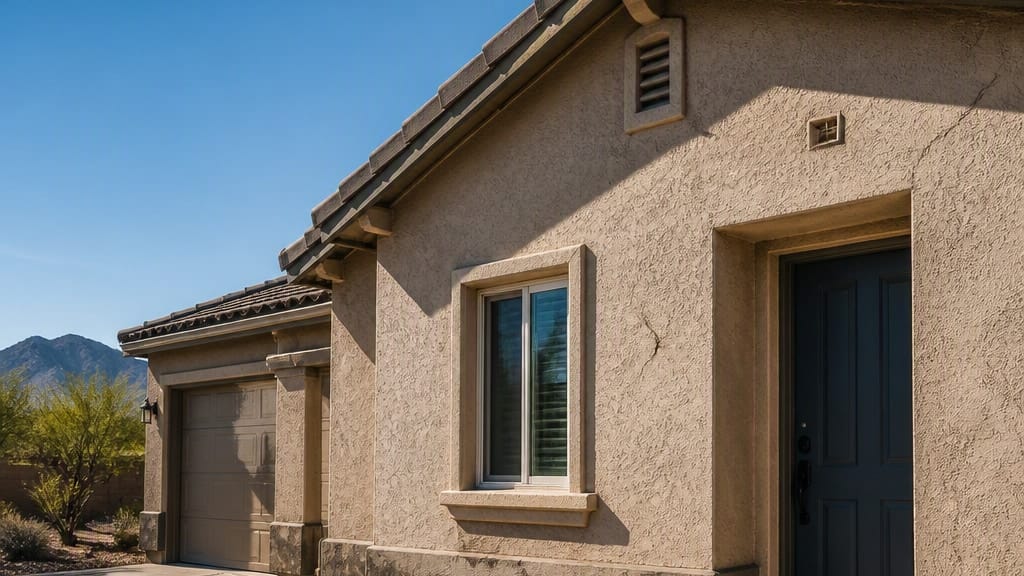
Stucco Cracks and Exterior Wear
Stucco makes homeowners nervous, and mostly it should not.
Stucco is a rigid cement-based finish applied over a structure that moves. It moves with temperature, it moves as the building settles, and it moves as the soil beneath it changes moisture content. Rigid material over a moving substrate produces cracks. That is normal behaviour, not a defect.
Hairline cracks — the ones you notice only in raking light, thin enough that you would struggle to get a fingernail into them — are extremely common and, on their own, are usually nothing more than the finish doing what the finish does. They very often appear at the corners of windows and doors, because those corners are stress concentrations in any wall.
What actually deserves attention is not size on its own. It is change, pattern, and water.
- Change — a crack that is visibly wider, longer, or offset compared with the last time you looked
- Pattern — cracks that run diagonally from opening corners, follow a stair-step line, or appear on both sides of the same wall in the same place
- Water — any crack with staining below it, dampness around it, or efflorescence, the white powdery mineral deposit left behind when water has moved through masonry and evaporated
I want to be direct about the limits of what anyone can tell from a photograph or a crack width, including me. Crack size alone does not diagnose a structural problem. A wide crack can be a surface issue and a narrow one can be a symptom of movement. The way you tell the difference is with time, documentation, and where it is genuinely warranted, a professional assessment by someone qualified to evaluate structure.
Which is why the useful homeowner habit here is simply to record. Photograph anything that concerns you, with something in frame for scale, and note the date. Six months later, take the same photograph. A crack that is identical is telling you something reassuring. A crack that has moved is telling you to get advice.
The other exterior point worth making is that failed sealing contributes to water intrusion. Where stucco meets a window, a door, a roofline, a pipe penetration or a light fixture, there is a joint, and that joint is sealed. When those seals harden and separate — which, as covered above, is exactly what our climate does to them — water has a path into the wall assembly. Very often the problem is not the crack anybody is worrying about. It is the failed joint above it.
When to Call a Pro
Get a professional evaluation for: any crack that has measurably moved or widened, diagonal or stair-step cracking from the corners of openings, cracks accompanied by doors or windows that have started binding, active water intrusion, or damp and staining inside a wall. Structural assessment is not handyman work, and neither is chasing a leak inside a wall assembly. Sealing over any of these without understanding the cause hides the evidence and keeps the water.
Plumbing Valves, Fixtures and Interior Wear
This section overlaps with hard water on purpose, because the mechanism is the same but the consequences are different. Here we are talking about the components whose job is to control water, and what happens when they cannot.
Angle stops are the small valves under sinks and behind toilets. They exist so you can isolate one fixture without shutting off the house. As covered earlier, mineral deposits build on the stem and seat over years of sitting still, and the valve seizes. Two failure modes follow, and both are bad at the wrong moment: it will not turn at all, or it turns but no longer shuts off completely.
Your main shutoff is the one every homeowner should know cold. Where it is, what it looks like, which way it turns, and whether anything is stacked in front of it. If you take one thing from this entire guide, take that one — the difference between knowing and not knowing is the difference between a wet cabinet and a wet house.
Supply lines are the flexible braided hoses running from the stops to the fixtures. They do not last forever. The braid can corrode, the connections can weep, and the failure mode when one lets go is not a drip.
Faucet cartridges wear from mineral grit the way sandpaper wears a surface. A stiff handle, a drip that will not stop, or a temperature that wanders is usually a cartridge.
Toilet internals — fill valve, flapper, seat — are the highest-turnover parts in the house, and here they wear faster than the packaging suggests, because the water they sit in is doing the wearing.
Why do these get difficult to operate? Because a valve is a moving part in a mineral bath. Every time water sits still in it, a little more deposit forms on the exact surfaces that need to move and seal. It is not neglect and it is not poor quality. It is chemistry and time.
What you can safely inspect: everything visible. Look under sinks with a flashlight for crust, drips, corrosion or staining on the cabinet base. Check whether stops look wet or mineral-caked at the stem. Feel supply lines for stiffness or corrosion. Watch and listen to toilets. All of that is free and none of it requires a tool.
What you should not do: force a stiff valve. I will say it a third time because it is the single most common way a manageable problem becomes an emergency in this city.
Proactive replacement makes sense when a component is old, when it is hard to access, when a failure would be expensive, or when someone is working in that spot anyway. Those four conditions cover most of the cases where I would say do it now rather than wait. If you want the fuller version of how I weigh that trade-off, it is in my guide on repairing versus replacing.
Seasonal Maintenance, Vegas Style
Most maintenance calendars are written for a climate that has four real seasons and rain. Ours does not work that way. Here is the version that matches what this valley actually does to a house.
Spring
Spring is your preparation window. Whatever you fix now, you fix before the heat arrives to test it — and everything you neglect now gets found by June.
Summer
Summer is not a repair season, it is an observation season. The heat is actively revealing problems, so this is the time to notice them rather than to start projects on a west-facing wall at two in the afternoon.
Fall
Autumn is the best working weather of the year here, and it is when I would do the actual repairs that summer identified.
Winter
Our winters are mild but not harmless. Freezing nights happen, and the things that get damaged are the things nobody protected because it does not usually freeze.
Four short walks a year. None of them takes an afternoon, and between them they catch the large majority of what I get called out for. If you want a broader version of this beyond desert-specific concerns, my preventative maintenance guide covers the general ground.
The Vegas Homeowner Toolkit
You do not need a workshop. You need enough to look properly, deal with the small things, and know when to stop. I have grouped these by what they are for rather than listing hardware for its own sake.
Inspection
This is the category that matters most, because nearly everything in this guide is a looking problem before it is a fixing problem.
- A genuinely bright flashlight — the ones built into phones are not good enough under a cabinet
- A step stool that lets you see the top of doors, gates and window frames
- Your phone camera, used deliberately: same angle, same spot, dated
Basic maintenance
Enough to handle aerators, loose hardware and the small adjustments that stop problems growing.
- A set of screwdrivers in the common sizes, flat and cross-head
- An adjustable wrench and a pair of pliers
- A small level for checking whether a door or a fixture has actually moved
- A utility knife with fresh blades
Leak and water awareness
Given everything above about hard water and valves, this is the category with the best return in a Las Vegas home.
- Battery leak alarms placed under sinks, behind toilets and near the water heater
- A moisture meter if you want to check a suspicious wall or cabinet base properly
- A few towels and a shallow tray kept where the water problems actually happen
Doors and seals
The consumables our climate destroys fastest, worth keeping on hand because you will use them.
- Weatherstripping in the profile your doors take
- A caulk gun and exterior-grade sealant suitable for the joints you are sealing
- Spare screws in the sizes your hinges and strike plates use
Safety
- Fresh batteries for smoke and carbon monoxide detectors
- Safety glasses, because eye injuries are the ones that do not heal
- Awareness of where your main water shutoff and electrical panel are, and clear access to both
A note on shutoff keys and specialist tools: whether you need one depends entirely on what your property has. Some homes here need a key for a curb stop or a specific valve type; many do not. Find out what your house actually has before buying anything, rather than the other way round. If you want a broader starting kit, I have covered that ground in essential tools for new homeowners.
DIY or Call a Pro
I would rather you did the safe things confidently than avoid everything out of caution. So here is where I think the line sits.
Comfortably homeowner work: anything visual. Cleaning aerators and showerheads. Replacing weatherstripping. Straightforward exterior caulking on accessible joints. Tightening hardware that has worked loose. Changing filters and detector batteries. Placing leak alarms. Photographing and monitoring anything you are unsure about.
Reasonable with some experience: replacing a toilet flapper or fill valve. Swapping a faucet aerator assembly. Adjusting a strike plate. Replacing an accessible supply line with the water safely off — provided the stop works properly, which brings us back to the same theme.
Not homeowner work, and not handyman work either in several cases:
When to Call a Pro
Call the appropriate licensed trade for: any electrical work beyond resetting a breaker or changing a bulb, and immediately for any outlet that is warm, discoloured, buzzing or intermittent. Any suspected gas issue, at any strength — leave and call from outside. Active water intrusion, or water inside a wall or ceiling. Structural concerns, including cracking that has moved or doors and windows binding alongside it. Any main line, sewer or water heater failure. And anything at height or in a confined space that you are not equipped for.
I am not trying to make anybody nervous about their own house. Most of what goes wrong here is small, cheap and slow, and you can handle a good deal of it. The judgement worth developing is not whether you can turn the wrench. It is whether the small thing in front of you is a small thing, or the visible corner of a larger one.
Owning a Home in the Desert
Las Vegas homes are not fragile. I want to be clear about that, because guides like this can leave people feeling like their house is under siege. It is not. These homes are built for this place and they hold up well.
What they are is exposed, in a specific and predictable way. The sun, the heat swing, the dryness and the water are constants, and they work on a known set of components in a known order. That predictability is the good news buried in everything above. You are not waiting for random misfortune. You are maintaining a short list of parts that this particular environment is hard on.
And almost every expensive thing I get called to started as something visible. The seized stop was crusted for years. The failed caulk joint was chalky and separating long before water got in. The door that will not latch was dragging for a season first. The water heater made noise before it leaked. Not one of those needed special equipment to notice — they needed somebody to look, and to recognise what they were looking at.
That is really the whole argument for maintenance, and it is an economic one rather than a moral one. Planned work happens on a weekday, at a normal rate, with the part in stock and you deciding the timing. The same work after a failure happens on a schedule you do not control, alongside whatever the water damaged on the way. The repair is the same repair. Everything around it is what changed.
So walk your house four times a year. Look at the sunny side and compare it against the shaded side. Turn things on and off. Get under the sinks with a decent flashlight. Photograph what you are unsure about and look again in six months. Know where your shutoff is.
Do that, and you will find most of it while it is still cheap. That is not a trick of the trade — it is just paying attention to a house in a place that asks a lot of it.
“Las Vegas homes don't fail suddenly. They fail quietly, then all at once.”
What I Usually Find
Angle stops under sinks that have not been turned in fifteen years
Weatherstripping baked flat and no longer touching the door
Exterior caulk that has gone hard and pulled away from the joint
Aerators and showerheads restricted with mineral scale
Water heaters carrying years of sediment nobody has flushed
Sun-facing doors and trim aged years ahead of the shaded side
First Safe Checks
1
Walk the water side
Every valve, aerator, supply line and toilet. These are the cheapest parts in the house and the ones hard water reaches first.
2
Walk the sun side
Whatever faces south and west ages fastest. Compare it against the shaded side of the same house and the difference tells you a lot.
3
Open and close everything
Doors, windows, gates. Operation problems show up long before anything looks broken.
4
Write down what changed
Not what is wrong. What is different from last time you looked. That is the useful list.
Call Today If You Notice
- ◆Water you can see or hear that you cannot explain
- ◆A crack that has visibly moved, widened or stepped since you last looked
- ◆Any outlet or switch that is warm, discoloured, buzzing or intermittent
- ◆The smell of gas, at any strength, anywhere
- ◆Staining or softness spreading on a wall, ceiling or cabinet base
Common Mistakes
- ✕Forcing a seized shutoff valve instead of leaving it and getting it replaced
- ✕Caulking over a failed joint without removing what already let go
- ✕Replacing a faucet cartridge repeatedly without addressing the scale feeding it
- ✕Treating every stucco hairline as an emergency, and every big crack as cosmetic
- ✕Waiting for a small maintenance item to become an after-hours emergency
FAQ
Do Las Vegas homes really wear out faster?
Not the structure. The finishes, seals and water-side components do, and that is where nearly all of the avoidable expense lives.
Is a water softener worth it?
It depends on the house and how much you are already spending on scale-related repairs. It is a real decision worth pricing properly, not an automatic yes.
How often should I actually be checking things?
Four short walks a year, at the change of seasons, catches most of what I get called out for.
Are hairline stucco cracks a problem?
Usually not by themselves. What matters is whether a crack is moving, whether it is letting water in, and whether it lines up with something structural.
What is the single highest-value thing I can do?
Know where your main water shutoff is and confirm it works before you need it in a hurry.
Desert home maintenance
Want a second set of eyes on the list?
Send photos of whatever you found on your walk around. I will tell you what is normal desert wear, what is worth doing now, and what can wait.
Read Next
Field Report • Las Vegas Plumbing Repairs
Hard Water Damage in Las Vegas: What Breaks, What I Repair, and When to Replace
Read Article →
Las Vegas Home Report • Plumbing
The Complete Las Vegas Hard Water Guide: What It's Doing to Your Home Right Now
Read Article →
Plumbing • Las Vegas Cost Guide
Leaking Pipe Under Your Sink? Here's What Las Vegas Homeowners Usually Pay To Fix It
Read Article →